“I spend all day interacting with intelligent systems. Very few of the physical environments around me feel equally considered.”
Environmental intelligence often stops at the sensor while overlooking the material conditions surrounding the person.

Exploring the material conditions of adaptive environments.
How might material properties reduce environmental burden and create more supportive conditions for human experience?
A speculative material-research platform exploring how bio-derived, regenerative, and conventional materials might contribute to more human-compatible environments.
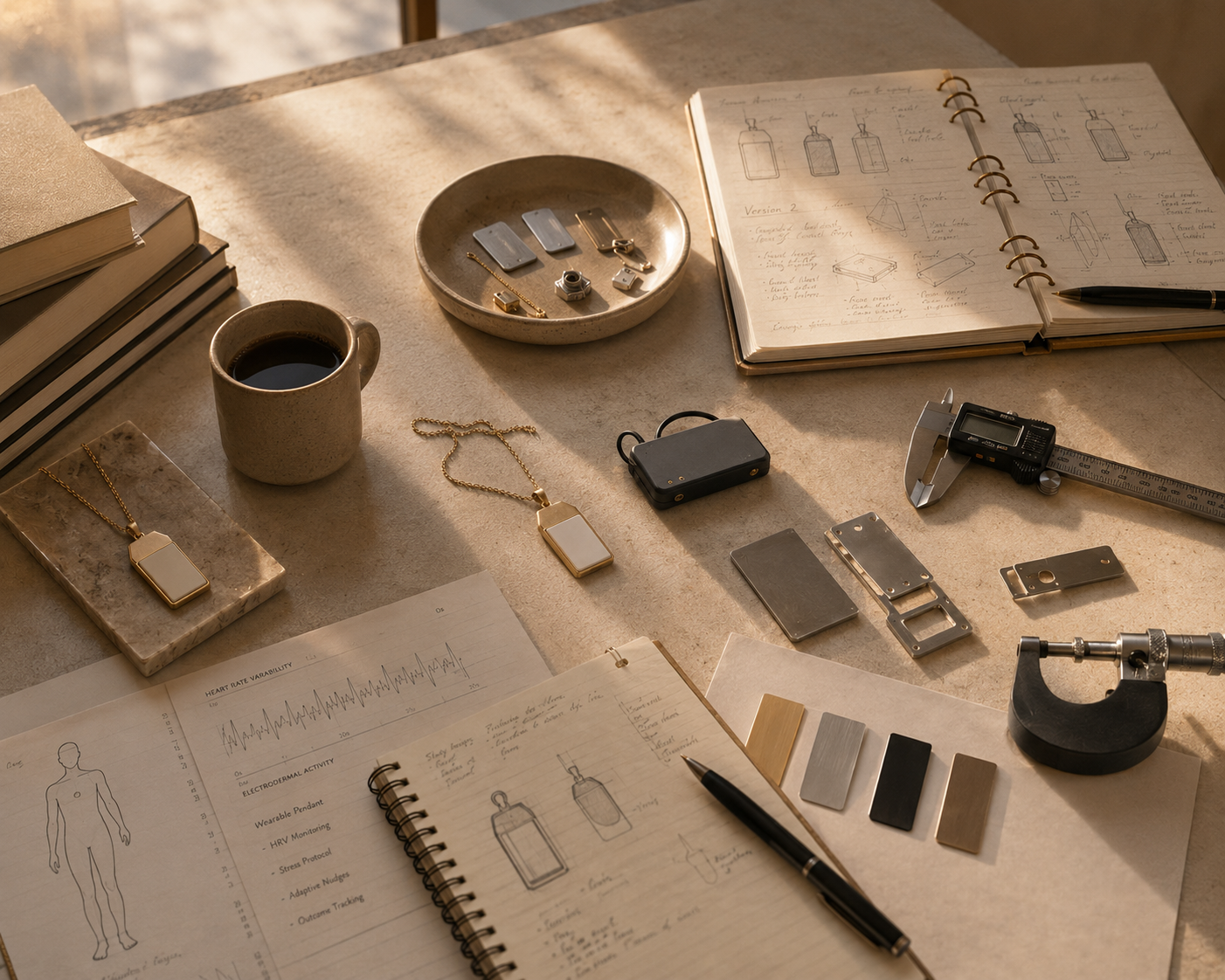
Material study — properties measured before provenance is assumed.
Before a person interprets information or responds to an intelligent system, the body is already encountering the physical world. Materials are often evaluated through technical performance, appearance, and price — their contribution to sensory and physiological experience may receive less attention.
The challenge may be understanding what the material environment is asking the body to tolerate.
Create material environments that support comfort, use, and changing conditions.
Develop surroundings that feel considered, coherent, and less demanding.
Explore material systems with more responsible sourcing, use, reuse, and end-of-life pathways.
Materials do not need computation to shape experience. Their physical properties already influence heat transfer, moisture behavior, acoustic absorption, tactile experience, visual softness or glare, weight, perceived warmth, and aging.
Biomaterials introduce additional questions involving sourcing, variability, fabrication, decomposition, and ecological impact.
Before asking how an environment should respond, we should ask what conditions its materials already create.
The project began with grape-waste leather alternatives and expanded into a broader study. Vitis does not assume a bio-derived material is automatically safer, more sustainable, or more comfortable — it asks how each performs across human and environmental criteria.
Texture, softness, friction, sound, odor, visual character, and user preference.
Insulation, breathability, heat retention, moisture absorption, drying, and surface temperature.
Strength, flexibility, abrasion resistance, cleanability, dimensional stability, and aging.
Irritation, allergen risk, chemical treatments, hygiene requirements, and suitability for context.
Feedstock, manufacturing inputs, repairability, persistence, recyclability, biodegradation, and disposal.
Familiarity, perceived naturalness, care rituals, provenance, and the narratives materials carry.
A workspace combines materials selected for acoustic absorption, tactile comfort, and thermal performance. The environment may feel quieter and less visually harsh.
The question is not whether materials appear natural — it is whether measurable acoustic conditions and user experience improve.
A wearable accessory uses a grape-derived composite with a breathable textile backing — evaluated for flexibility, heat retention, moisture, skin comfort, odor, durability, and repairability.
The biomaterial is not treated as inherently beneficial. It is treated as a design hypothesis.
A recovery space uses materials selected for surface warmth, sound absorption, cleanability, and sensory predictability. No new digital interface is required.
The material composition changes the baseline quality of the environment.
Evaluate what the material does — not only where it came from.
A novel biomaterial has little value if it creates discomfort, contamination, or rapid failure.
Improve the baseline environment before adding sensors and automation.
Do not solve human comfort by creating an indefensible environmental lifecycle — or vice versa.
Test emerging materials against relevant conventional benchmarks.
Do not equate “bio-based,” “natural,” “biodegradable,” or “regenerative” with proven health or sustainability benefits.
Vitis is grounded in established knowledge about material properties, environmental comfort, sensory experience, biomaterials, and lifecycle design. The specific materials and integrated applications remain conceptual or early-stage unless individual prototypes have been fabricated and tested.
Claims regarding stress reduction, physiological regulation, biological compatibility, or improved wellbeing would require defined materials, comparison conditions, and empirical evaluation.
The aim is not to find one universally “good” material. It is to understand which material systems create better conditions for specific people and contexts.
Agricultural waste, cellulose systems, mycelium, and new composites expand the material palette.
Novel feedstocks do not automatically produce lower-impact or healthier products.
Comfort, acoustics, thermal conditions, and material perception are recognized as central concerns.
Intelligent environments still depend on the surfaces, structures, and fabrics through which adaptation is experienced.
Before an algorithm interprets a signal or an environment changes state, the body is already encountering the material world.
The material layer is not decoration around the interface. It is part of the interface.
Each investigates a shared question: what happens when the surrounding interface carries more of the burden of adaptation?