Back to Research
Pillar 01 — Environments

Adaptive Systems

Support embedded in environments.

What if environments could respond to changing human capacity?

Adaptive Systems explores how homes, rooms, workflows, and care environments might reduce friction, support transitions, and help people recover capacity before overload accumulates.

The work begins from a simple premise.

Human capacity changes. Most environments assume it does not.

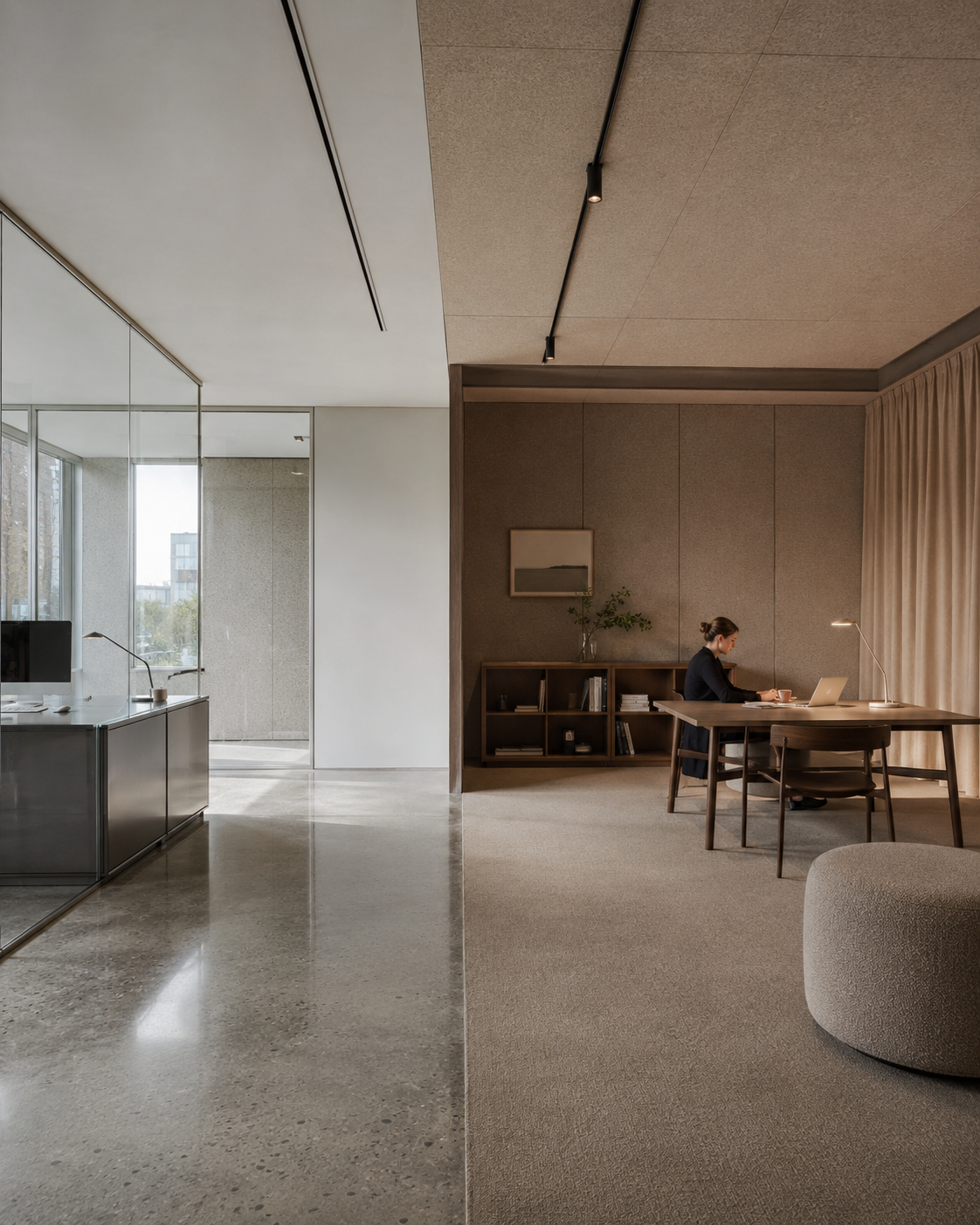
A calm, minimal interior — a person working quietly at a desk inside a softly lit, materially restrained room
Fig. 01 — Environment as support structure

Field study — the surrounding room carries part of the burden of adaptation.

A behavioral truth

The challenge may not be motivation. It may be environment mismatch.

Many everyday environments are designed around idealized consistency. They assume people can remember, initiate, prioritize, transition, orient, recover, and complete tasks with the same level of capacity throughout the day.

But capacity is not stable.

A person may begin with enough energy to start a task, but not enough to complete the final sequence.

A patient may receive excellent clinical care while the room itself disrupts rest, orientation, and recovery.

A caregiver may move from work into evening responsibilities without a meaningful threshold.

A knowledge worker may look away from the screen because attention has stopped cooperating.

Fig. 02 — Where friction lives Across a day
Assumed capacity Actual capacity ↕ Friction lives in the gap

Most environments ask people to keep adapting — to absorb the distance between what the day assumes and what the body can actually offer.

Adaptive Systems asks what becomes possible when the surrounding environment carries more of that burden.

What this layer studies

The environments we move through.

Adaptive Systems investigates the environments people move through when capacity becomes constrained — and how each might hold a little more of the structure.

01

Homes

How might living environments reduce the executive burden required to begin, transition between, and complete everyday activities?

02

Routines

How might physical interfaces reduce the decision burden required to close loops and finish ordinary tasks?

03

Recovery Spaces

How might healthcare environments reduce the sensory, cognitive, and emotional burden of recovery?

04

Restorative Thresholds

How might environments create opportunities for attentional restoration before cognitive fatigue accumulates?

Across these contexts, the same question returns:

What happens when the surrounding interface carries more of the burden of adaptation?

Featured concepts

Environments and support structures.

Adaptive Systems includes both speculative environments and practical support structures. Each concept begins with a moment where human capacity becomes constrained.

Concept 01 Speculative environment

Focus Habitat

Designing homes for fluctuating executive capacity.

Focus Habitat explores the home as cognitive infrastructure. Rather than adding another planner, reminder system, or productivity dashboard, the concept asks how the physical environment might make the next action easier to perceive.

Potential responses include contextual lighting, one-step prompts, visible time, object anchors, transition modes, and sensory simplification.

The goal is not to monitor every behavior. The goal is to reduce the hidden executive burden between intention and action.

Human constraintExecutive function
Transitionstuck → started
Evidence levelResearch-informed speculative environment
A warm entryway at dusk — a tote bag, keys on a tray, shoes, and a soft lamp by the door Home · object anchors · transition modes
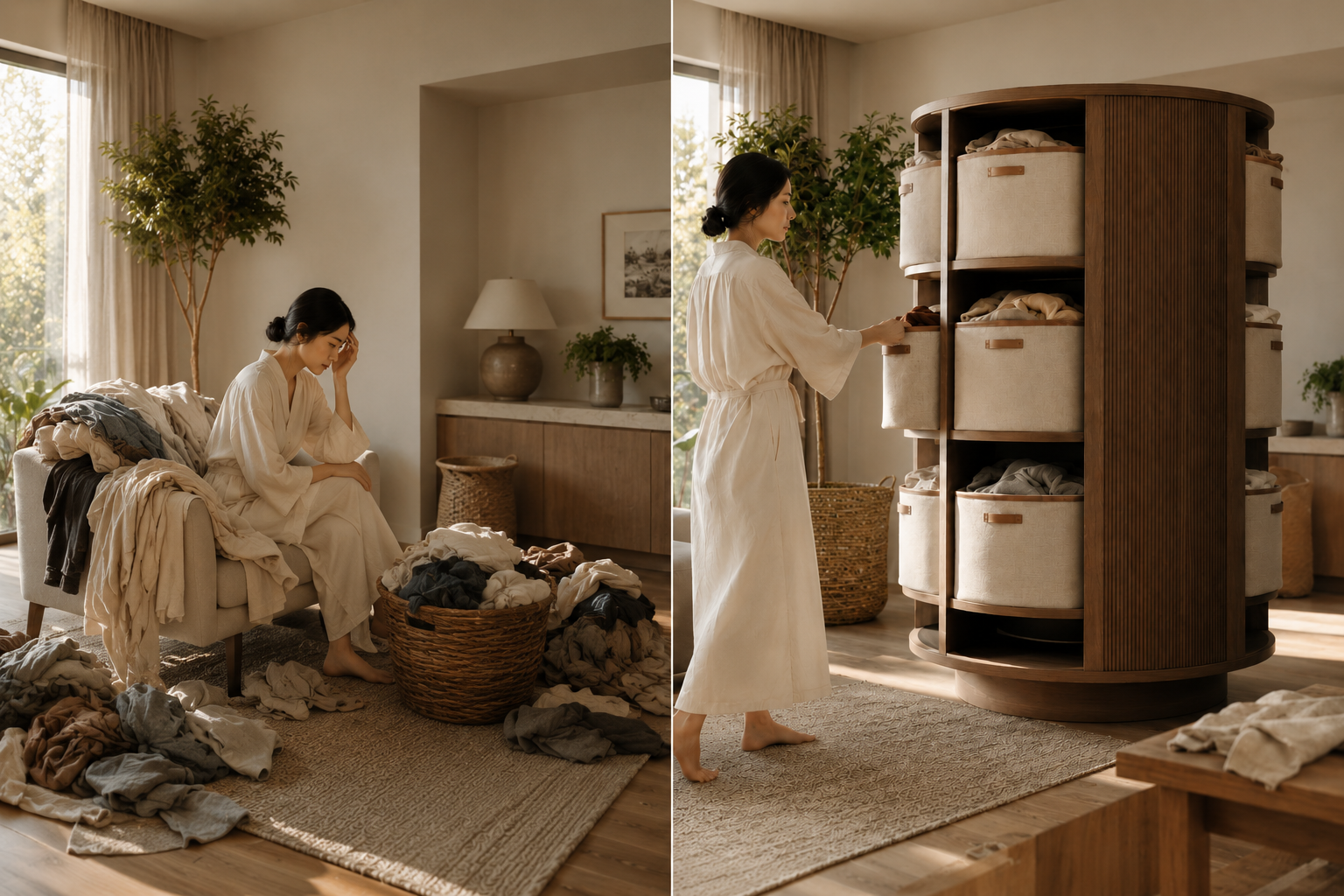
A diptych — on the left, a woman sits overwhelmed amid piles of unfolded laundry; on the right, she calmly places folded linens into a warm wooden rotating storage carousel Field observation — the pile, and the rotation
Conventional sequence
Laundry Sort Decide Navigate Open Store Repeat
Proposed sequence
Laundry Grab Rotate Place
Fig. 03 — Fewer steps to finished
Concept 02 Physical concept

Laundry Loop

Designing for the moment after motivation ends.

Laundry rarely fails at washing. It fails at completion. The clothes are clean, but the task still requires sorting, categorizing, carrying, navigating, folding, and storing. By the time those steps arrive, the energy that initiated the task may already be gone.

Laundry Loop explores whether a physical storage interface can carry more of the task structure — bringing several categories into one visible interaction instead of several locations.

The goal is not maximum storage density. The goal is a more finishable task.

Human constraintTask completion
Transitionalmost done → complete
Evidence levelResearch-informed physical concept
A woman pauses at a sunlit desk beside a window full of trailing green plants, looking out Window · living installation · restorative threshold
Concept 03 Restorative-environment concept

Wild Window

Designing spaces where attention can rest.

Attention is finite. Many contemporary environments continuously consume it through notifications, decisions, messages, interruptions, visual competition, and task switching.

Wild Window explores how restorative natural cues might be introduced into environments where direct access to nature is limited. It is not decoration or digital entertainment. It is an environmental pause point.

Potential expressions include framed natural views, living installations, dynamic daylight, weather-responsive scenes, mediated landscapes, and restorative thresholds.

The goal is not to capture attention. It is to stop competing for it.

Human constraintAttentional restoration
Transitioncognitive strain → soft recovery
Evidence levelResearch-informed restorative concept
A quiet room at first light — soft linen bedding, a glass of water and a book on the bedside table by a window Recovery space · soft pathway lighting · orientation
Concept 04 Speculative environment

AttuneCare

Designing healthcare environments that participate in recovery.

Hospitals heal bodies. They often dysregulate minds. AttuneCare explores how a patient room might respond to changing human capacity during illness, uncertainty, pain, medication effects, and interrupted sleep.

The goal is not to fill the room with more technology. The goal is to coordinate existing environmental systems around the changing capacity of the patient.

Six environmental layers
Circadian lighting Pathway guidance Orientation support Acoustic modulation Passive environmental sensing Care-team cueing
Human constraintRecovery
Transitiondisorientation → orientation
Focus Habitat field tools

Small, practical tools for everyday capacity.

Focus Habitat is not only a speculative home environment. It also includes small, practical tools for reducing the executive burden of everyday life.

Object Anchors

Designated places for essential objects — visible enough to reduce search behavior, stable enough to support return.

One-Step Prompts

Printable prompts that reduce task initiation into a single visible next action.

Transition Modes

Environmental states that support common shifts: departure, focus, meal, recovery, and evening.

Boundary Signals

Simple environmental cues, such as a boundary lamp, that help households communicate availability, focus, rest, or transition without repeated negotiation.

Completion Supports

Interfaces like Laundry Loop that reduce the number of decisions between starting a task and finishing it.

Move structure out of memory and into the environment.

A note on how these travel

Some tools may become printable field tools, small-batch prototypes, or community-supported experiments.

Transition modes

Designing for the state changes that happen every day.

One way Adaptive Systems reduces friction is by designing for repeated state changes — the ordinary thresholds a person crosses again and again.

Mode 01

Departure

Leaving the house with fewer forgotten essentials, fewer repeated checks, and less last-minute friction.

Mode 02

Focus

Entering a task with one visible next action and fewer competing signals.

Mode 03

Meal

Moving from scattered hunger or decision fatigue into a prepared food routine.

Mode 04

Recovery

Creating conditions for sensory downshift, rest, or nervous-system return.

Mode 05

Evening

Closing loops, reducing visual noise, and preparing the environment for tomorrow.

Design principles

Reduce burden without reducing agency.

Adaptive Systems are guided by principles that keep support quiet, optional, and in the hands of the person it serves.

01

Reduce Activation Energy

Make the first useful action easier to identify and perform.

02

Externalize What Must Be Remembered

Do not require working memory when the environment can hold the information.

03

One Signal at a Time

Reduce competing cues and surface only what is relevant now.

04

Shame-Free Interaction

Support without correction, scoring, or moral judgment.

05

User-Controlled Adaptation

The person determines which routines, signals, and data the environment may use.

06

Graceful Failure

The system should remain usable when automation fails, the routine breaks, or the person chooses a different path.

Evidence maturity

A research-informed concept layer.

Adaptive Systems is currently a research-informed concept layer within Kutuhala Studio. The work draws from human-centered research, cognitive accessibility, environmental psychology, occupational therapy, healthcare design, sensory design, executive-function support, smart-home infrastructure, and adaptive systems thinking.

Individual concepts vary in maturity. Focus Habitat, Laundry Loop, Wild Window, and AttuneCare have not yet been validated as complete functional systems.

Claims about improved task completion, reduced stress, attentional restoration, recovery outcomes, or sustained adoption remain hypotheses.

Kutuhala uses speculative design to ask better questions — not to overstate evidence before it exists.

The maturity ladder — this layer sits at Concept
01

Observation

02

Concept

03

Prototype

04

Field Study

05

Research Program

Evidence level Research-informed concept layer
What future prototypes should test

A research checklist.

Before any environment can claim to help, these are the questions a future prototype would need to test — under real fatigue, interruption, and stress.

Time to task initiation
Completion rates
Perceived mental effort
Orientation and perceived control
Attentional fatigue before and after exposure
User preference across contexts and neurotypes
Supportiveness versus intrusiveness
Safety and accessibility
Whether benefits persist after novelty declines
Whether visible support creates additional burden
Workflow compatibility
Privacy and data boundaries
Real-world use under fatigue, interruption, or stress

The most important comparison is not whether the environment looks supportive.

It is whether people are more able to move between states when capacity is constrained.

Future hypothesis

Adaptive environments may reduce friction when they carry more of the context, sequence, timing, and recovery burden that people are otherwise expected to manage alone.

The central research question is not whether environments can become “smart.”

It is whether they can become more humane.

What this work suggests

Many everyday failures occur after intention has already succeeded.

The person began. The task started. The appointment was scheduled. The care was delivered. The room was occupied. The body was trying.

What failed was the surrounding system’s ability to support the next state.

Adaptive Systems asks how environments might become less extractive of human capacity — and more capable of giving some of it back.

Explore Transition Objects Explore Intervention Layer Work With Christine →