01
Homes
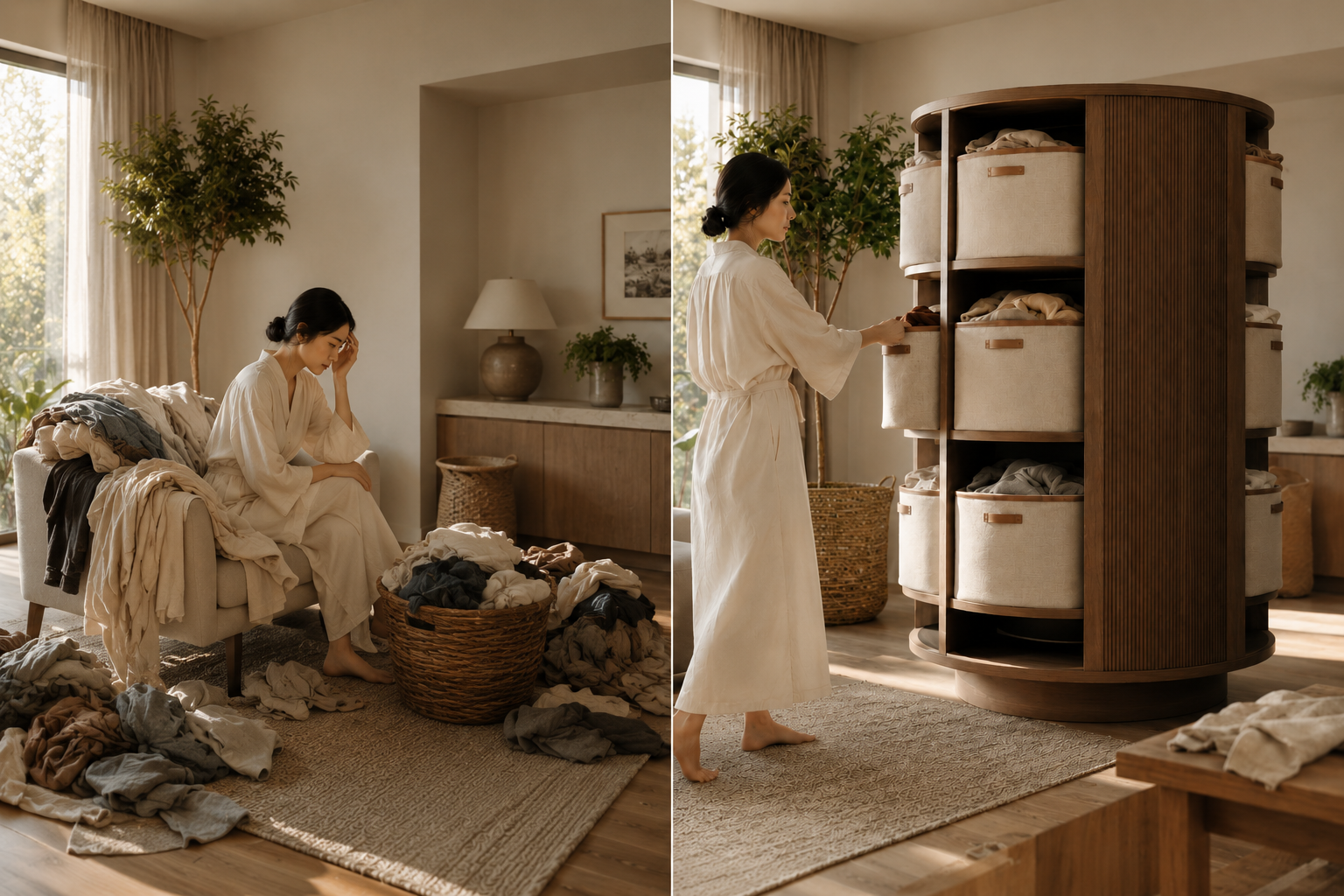
How might living environments reduce the executive burden required to begin, transition between, and complete everyday activities?
Support embedded in environments.
What if environments could respond to changing human capacity?
Adaptive Systems explores how homes, rooms, workflows, and care environments might reduce friction, support transitions, and help people recover capacity before overload accumulates.
The work begins from a simple premise.
Human capacity changes. Most environments assume it does not.
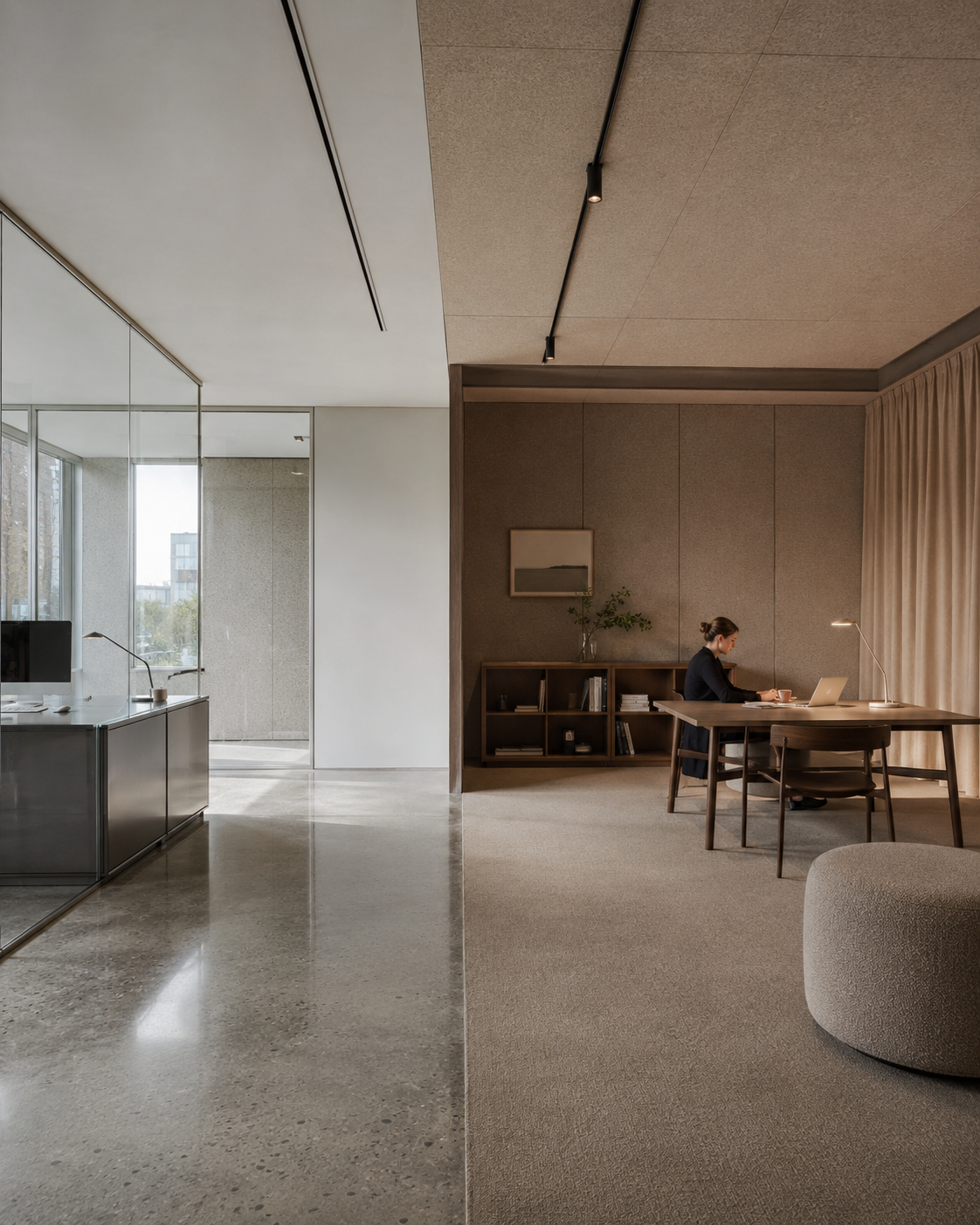
Field study — the surrounding room carries part of the burden of adaptation.
Many everyday environments are designed around idealized consistency. They assume people can remember, initiate, prioritize, transition, orient, recover, and complete tasks with the same level of capacity throughout the day.
But capacity is not stable.
A person may begin with enough energy to start a task, but not enough to complete the final sequence.
A patient may receive excellent clinical care while the room itself disrupts rest, orientation, and recovery.
A caregiver may move from work into evening responsibilities without a meaningful threshold.
A knowledge worker may look away from the screen because attention has stopped cooperating.
Most environments ask people to keep adapting — to absorb the distance between what the day assumes and what the body can actually offer.
Adaptive Systems asks what becomes possible when the surrounding environment carries more of that burden.
Adaptive Systems investigates the environments people move through when capacity becomes constrained — and how each might hold a little more of the structure.
How might living environments reduce the executive burden required to begin, transition between, and complete everyday activities?
How might physical interfaces reduce the decision burden required to close loops and finish ordinary tasks?
How might healthcare environments reduce the sensory, cognitive, and emotional burden of recovery?
How might environments create opportunities for attentional restoration before cognitive fatigue accumulates?
Across these contexts, the same question returns:
What happens when the surrounding interface carries more of the burden of adaptation?
Adaptive Systems includes both speculative environments and practical support structures. Each concept begins with a moment where human capacity becomes constrained.
Focus Habitat is not only a speculative home environment. It also includes small, practical tools for reducing the executive burden of everyday life.
Designated places for essential objects — visible enough to reduce search behavior, stable enough to support return.
Printable prompts that reduce task initiation into a single visible next action.
Environmental states that support common shifts: departure, focus, meal, recovery, and evening.
Simple environmental cues, such as a boundary lamp, that help households communicate availability, focus, rest, or transition without repeated negotiation.
Interfaces like Laundry Loop that reduce the number of decisions between starting a task and finishing it.
Move structure out of memory and into the environment.
Some tools may become printable field tools, small-batch prototypes, or community-supported experiments.
One way Adaptive Systems reduces friction is by designing for repeated state changes — the ordinary thresholds a person crosses again and again.
Adaptive Systems are guided by principles that keep support quiet, optional, and in the hands of the person it serves.
Make the first useful action easier to identify and perform.
Do not require working memory when the environment can hold the information.
Reduce competing cues and surface only what is relevant now.
Support without correction, scoring, or moral judgment.
The person determines which routines, signals, and data the environment may use.
The system should remain usable when automation fails, the routine breaks, or the person chooses a different path.
Adaptive Systems is currently a research-informed concept layer within Kutuhala Studio. The work draws from human-centered research, cognitive accessibility, environmental psychology, occupational therapy, healthcare design, sensory design, executive-function support, smart-home infrastructure, and adaptive systems thinking.
Individual concepts vary in maturity. Focus Habitat, Laundry Loop, Wild Window, and AttuneCare have not yet been validated as complete functional systems.
Claims about improved task completion, reduced stress, attentional restoration, recovery outcomes, or sustained adoption remain hypotheses.
Kutuhala uses speculative design to ask better questions — not to overstate evidence before it exists.
Before any environment can claim to help, these are the questions a future prototype would need to test — under real fatigue, interruption, and stress.
The most important comparison is not whether the environment looks supportive.
It is whether people are more able to move between states when capacity is constrained.
What failed was the surrounding system’s ability to support the next state.
Adaptive Systems asks how environments might become less extractive of human capacity — and more capable of giving some of it back.